
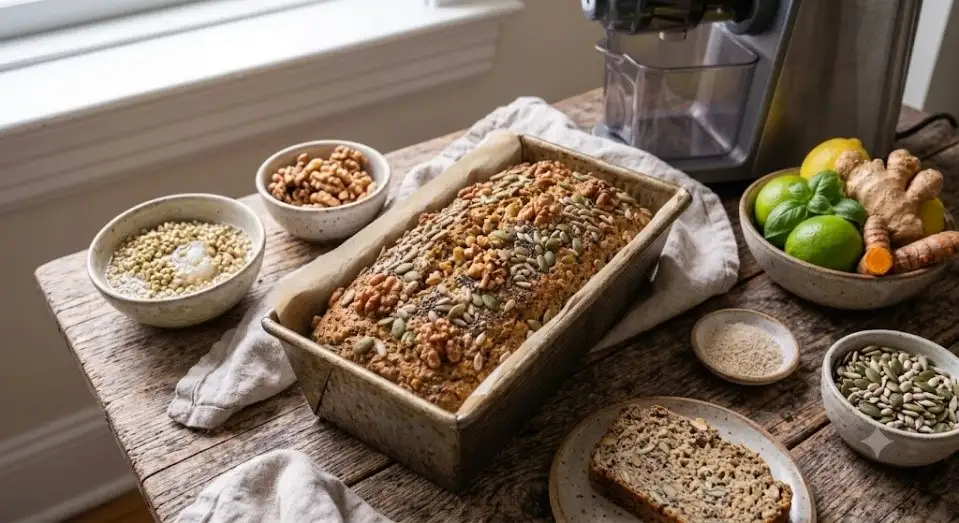
A rustic, naturally fermented plant-based loaf made from whole raw green buckwheat and crunchy walnuts. Rich in fiber, minerals, and healthy fats, this bread undergoes natural fermentation to develop its characteristic flavor and texture and may help reduce certain antinutritional compounds naturally present in buckwheat.
Ingredients
- 2 cups whole raw green buckwheat (unroasted)
- 1 cup filtered water (for blending, plus extra for soaking)
- 2 tbsp psyllium husk powder
- 3 tbsp raw chia seeds or ground flaxseeds
- ¼ cup raw pumpkin seeds
- ¼ cup raw sunflower seeds
- ⅓ cup raw walnuts (coarsely chopped)
- 1 tsp fine sea salt
- 1 tbsp extra virgin olive oil (for brushing the tin)
Instructions
- Rinse the green buckwheat thoroughly in a fine-mesh strainer under cold water. Place in a large glass bowl, cover generously with water, and let soak for 6–8 hours (or overnight).
- Drain the soaked buckwheat, but do not rinse off the natural gelatinous coating that forms around the grains.
- Transfer the drained buckwheat to a food processor or blender along with 1 cup of fresh filtered water and sea salt. Pulse until a thick, slightly coarse batter forms (avoid over-blending to a liquid).
- Pour the batter back into a glass bowl, cover loosely with a clean kitchen towel, and let sit at room temperature for 7–10 hours to naturally ferment (it may expand slightly and develop tiny air bubbles).
- Preheat oven to 175°C (350°F) and line a loaf pan with parchment paper lightly greased with olive oil.
- Gently fold the psyllium husk, chia seeds or ground flaxseeds, pumpkin seeds, sunflower seeds, and chopped walnuts into the fermented batter until evenly distributed.
- Pour the mix into the loaf pan, smooth the top with a spatula, and bake for 60–75 minutes until the crust is golden-brown and a toothpick inserted into the center comes out clean.
- Allow the bread to cool completely on a wire rack before slicing.
Nutritional Values & Benefits
- Natural Fermentation: Fermentation of buckwheat can reduce certain antinutritional compounds, including phytic acid, potentially improving the bioavailability of some minerals.
- Plant-Based Omega-3s & Healthy Fats: Walnuts and ground flaxseeds provide alpha-linolenic acid (ALA), a plant-based omega-3 fatty acid, while walnuts and seeds also contribute unsaturated fats and other nutrients.
Prebiotic & Soluble Fiber: Green buckwheat, psyllium, and chia seeds provide dietary fiber, including soluble and viscous fibers that contribute to digestive health and can help support a healthy post-meal glucose response.


Leave A Comment